Business Rule Management System Portlet
About BRMS in Platform
Business Rule Management System (BRMS) is used to define, deploy, execute, monitor and maintain the variety and complexity of decision logic that is used by operational systems within an organization or enterprise. The decision table in the platform uses BRMS.
About Decision Model and Notation
The Decision Table uses Decision Model and Notation (DMN), an international standard modeling language and notation for business decisions and business rules. DMN works on the principle of defining business decisions where a decision answers a specific business question. The answer (output) of the decision is based on the values of pre-defined input variables to the decision logic in an Inputs → Decision Logic → Answers (output) style. DMN configurations are done using the Friendly Enough Expression Language (FEEL), a simple but powerful way to provide logical, textual, mathematical, list processing, interval, date/time, and other functions business people need to make decisions. The Platform uses DMN for operational decisions in the tables using FEEL. Decisions are made and calculations are done for the output of the decision which directs the progress of the workflow.
The Platform uses DMN for operational decisions in the tables using FEEL. Decisions are made and calculations are done for the output of the decision which directs the progress of the workflow.
It is mandatory to understand DMN and FEEL before configuring the decision table.
Decision Tables and Decision Models
A Decision Table is used when you need to do some calculations based on conditions or rules and display the result. You can define multiple conditions and calculations in the decision table.
Decision Table portlet is mainly used for bulk input execution. Any application or process flow in the platform can utilize these decision tables through API.
The Decision Model is the input model that you create for your decision table. You can map the decision model to the decision table and apply the rules to it. When you create a decision model and define it, it is saved as a separate entity in the platform that can be utilized for multiple decision tables.
Adding BRMS Portlet in the Platform
-
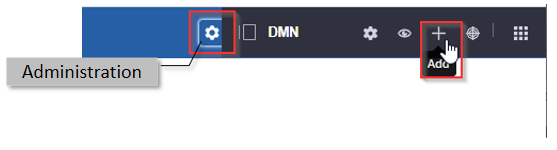
On the title bar, click the Administration icon.
-
Click the “+” icon. Add page panel appears on the right side of the platform.
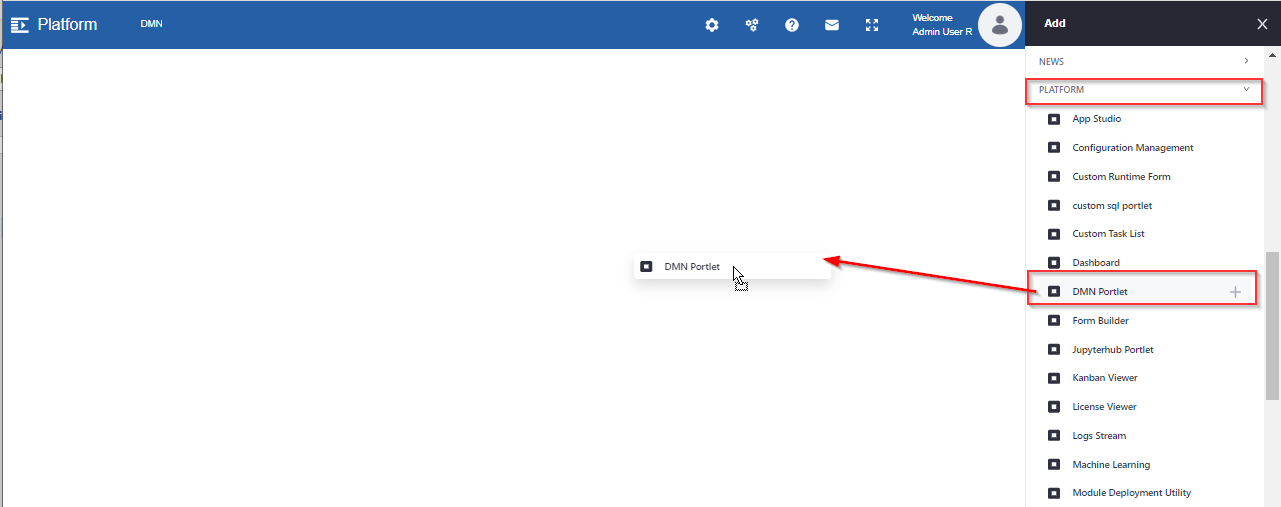
Figure 1: Dragging a BRMS portlet to a page -
From the “PLATFORM” category, drag the portlet named "BRMS” to the BRMS page.
Decision table or Decision Model page appears as per the configuration. In the configuration, you can select the Decision table or decision model to appear on the page.
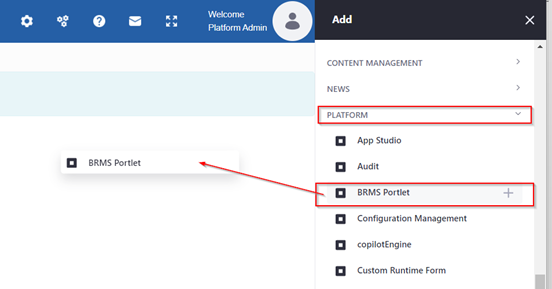
Figure 2: BRMS portlet with Decision Model list
Configuring the BRMS Portlet
The BRMS portlet displays the details of the Decision Table or Decision model based on the configuration. You can configure the BRMS portlet to view the Decision Table or Decision Model.
-
In the main menu click BRMS page to navigate to BRMS page. If the widget is already added to the page, you can view the configured widget on the BRMS page.
-
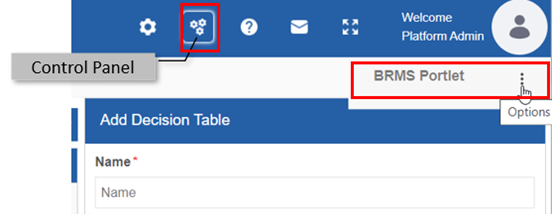
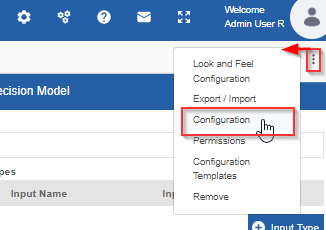
On the titile bar, click Control Panel icon and then hover over the page below. The portlet name appears with options.
-
Click the three dots.
-
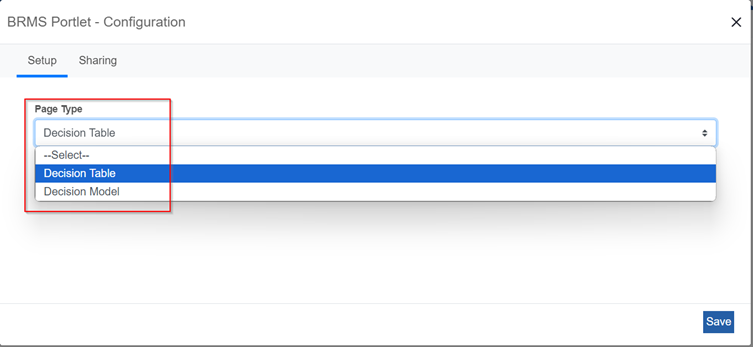
Click Configuration. Widget configuration details appear.
-
In the Page Type, select the type of the widget details that you want to view on the BRMS page.
-
Decision Table: The list of decision tables appear with the details along with the option to create decision table.
-
Decision Model: The list of decision tables appear with the details along with the option to create decision model.
-
-
Click Save to save the configuration.
Searching for a Decision Model / Decision Table
-
In the Search by Name box enter the name (or a few letters) of the decision model that you want to search.
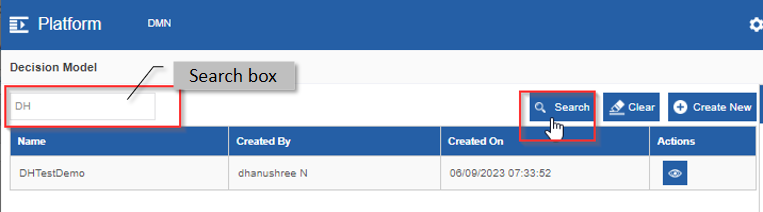
Figure 3: Searching for a table or model name -
Click Search. Model names that match the search text are filtered and displayed.
-
Click Clear to clear the search filtering.
Viewing and Editing Decision Model Details
- In the main menu, navigate to BRMS page.
-
In the widget configuration (Control Panel icon > Options > Configuration) select Decision Table and click Save. The decision model list appears on the page. (If you do not see any change in the page, refresh the page.)
The decision models that are created for the organization appear.
-
Name: Name of the decision model.
-
Created By: User who created the decision model.
-
Created On: Date and time on which the decision model was created.
-
Actions: Click eye icon to view the details on the right-side panel.
-
-
In the Actions, click the eye icon of any decision table to preview the corresponding details on the right-side panel.
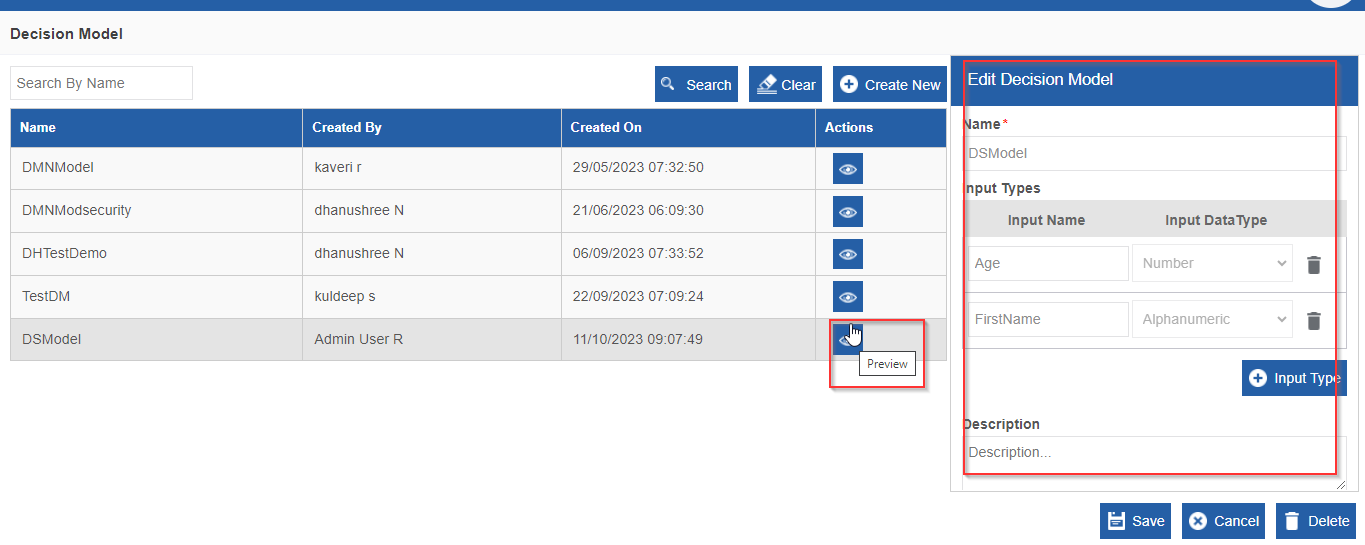
Figure 4: Decision Models and details -
Edit the details as required. You can even add more Input Types.
-
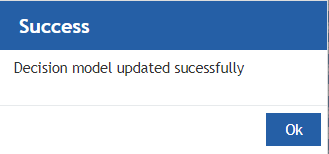
Click Save. A Success message appears on successful update of the details.
-
Click OK.
Creating a New Decision Model
- In the main menu, navigate to BRMS page.
-
In the widget configuration (Control Panel icon > Options > Configuration) select Decision Model and click Save (Close the pop-up). The decision model list appears on the page. (If you do not see any change in the page, refresh the page.)
-
Click Create New.
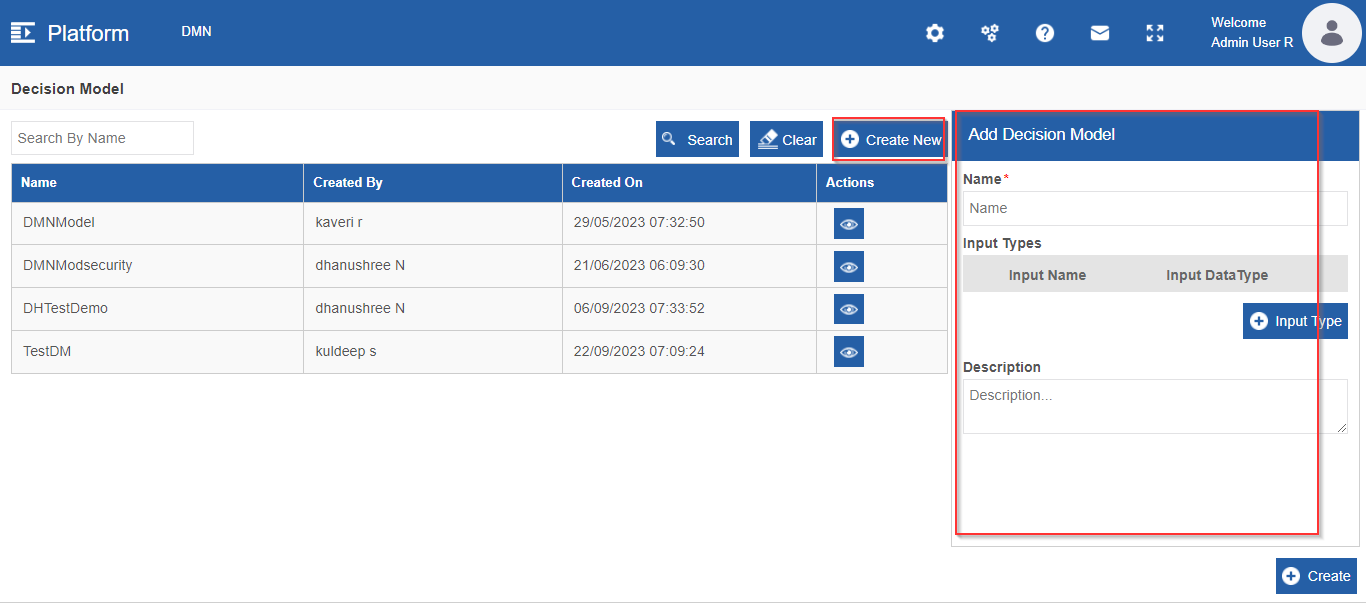
Figure 5: Creating a new data model -
In the Properties panel on the right side enter the details as explained below.
Field Description Name Enter the name for the decision model. Input Types Click Input Type button. Name and DataType boxes appear.
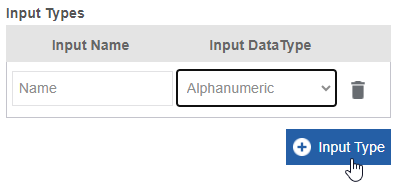
Enter the name in the Input Name box.
Select the data type from the Input Data Type list.
Click Input Type button again to add multiple Input data.Description Enter a description for the decision table if any. -
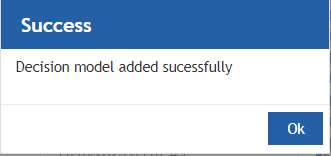
Click Create. A Success message appears on successful creation of the decision modal.
-
Click Ok.
Deleting a Decision Model
- In the main menu, navigate to BRMS page.
-
In the widget configuration (Control Panel icon > Options > Configuration) select Decision Model and click Save. The decision model list appears on the page. (If you do not see any change in the page, refresh the page.)
-
In the Actions, click the eye icon of the record that you need to delete.
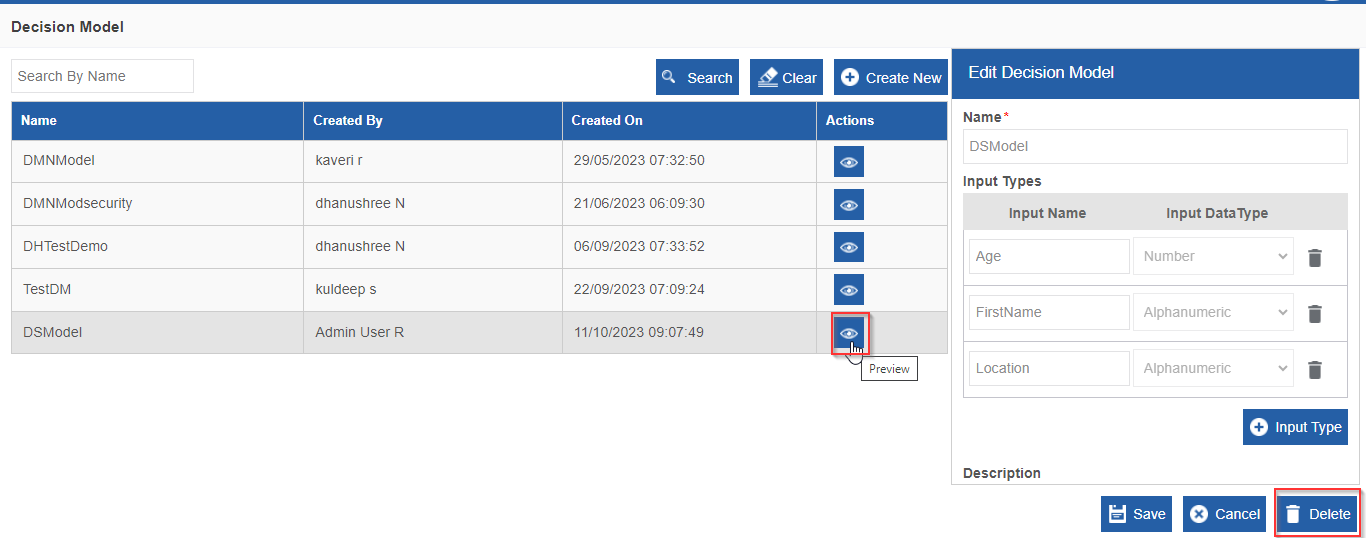
Figure 6: Deleting a Decision Model -
Click Delete.
-
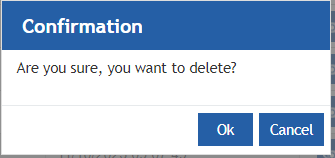
Click Ok to delete or click Cancel to discard the action.
Viewing and Editing Decision Table Details
- In the main menu, navigate to BRMS page.
-
In the widget configuration select Decision Table and click Save. Decision Table appears on the page. (If you do not see any change in the page, refresh the page)
The decision tables that are created for the organization appears.
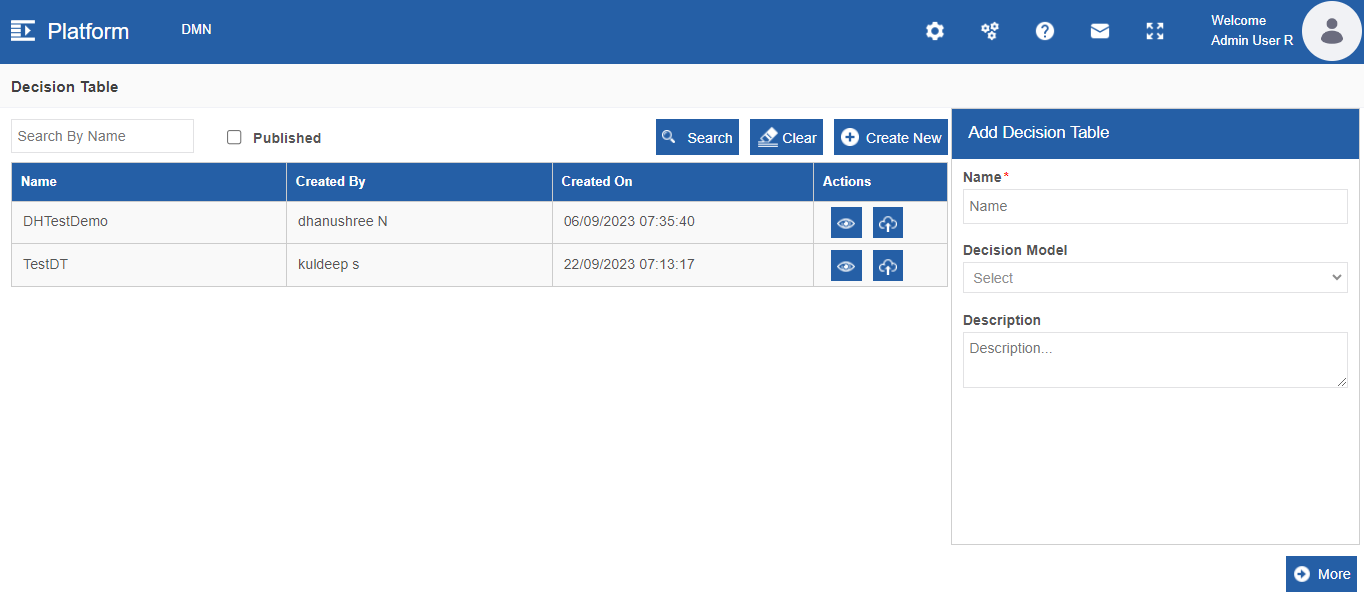
Figure 7: Decision Tables and details-
Name: Name of the decision table.
-
Created By: User who created the decision table.
-
Created On: Date and time on which the decision table was created.
-
Actions: Click eye icon to view the details of the right-side panel and click the publish icon to publish the decision table.
-
-
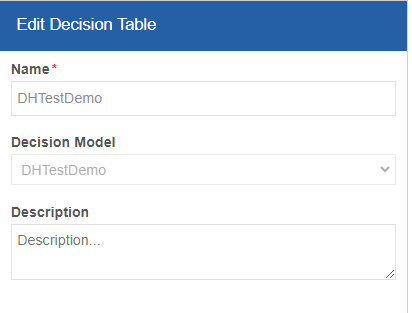
In the Actions, click the eye icon of any decision table to preview the corresponding details on the right side panel.
-
Edit the details as per your need. Note that you cannot edit the Name or change the Decision Model.
-
Click More to view the complete configuration details of the decision table.
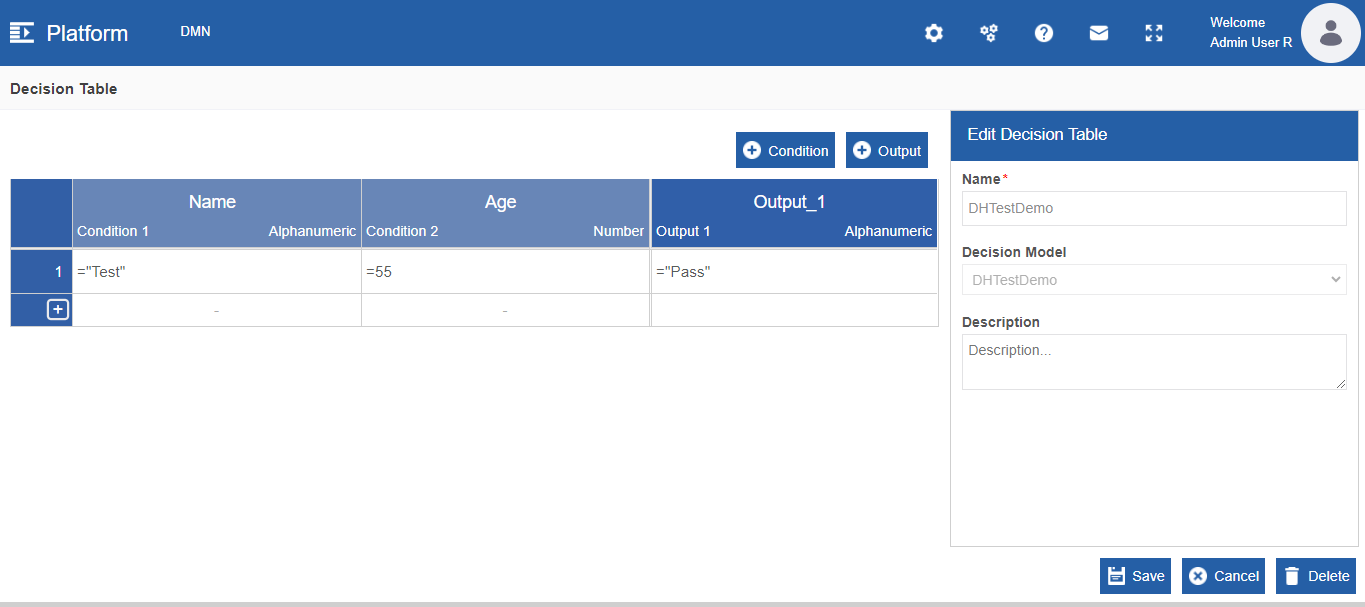
Figure 8: Decision Table More details -
Edit the required rules and conditions.
-
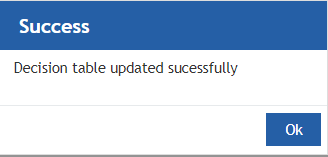
Click Save. A Success message appears on successful update of the details.
-
Click Ok.
Creating a New Decision Table
- In the main menu, navigate to BRMS page.
-
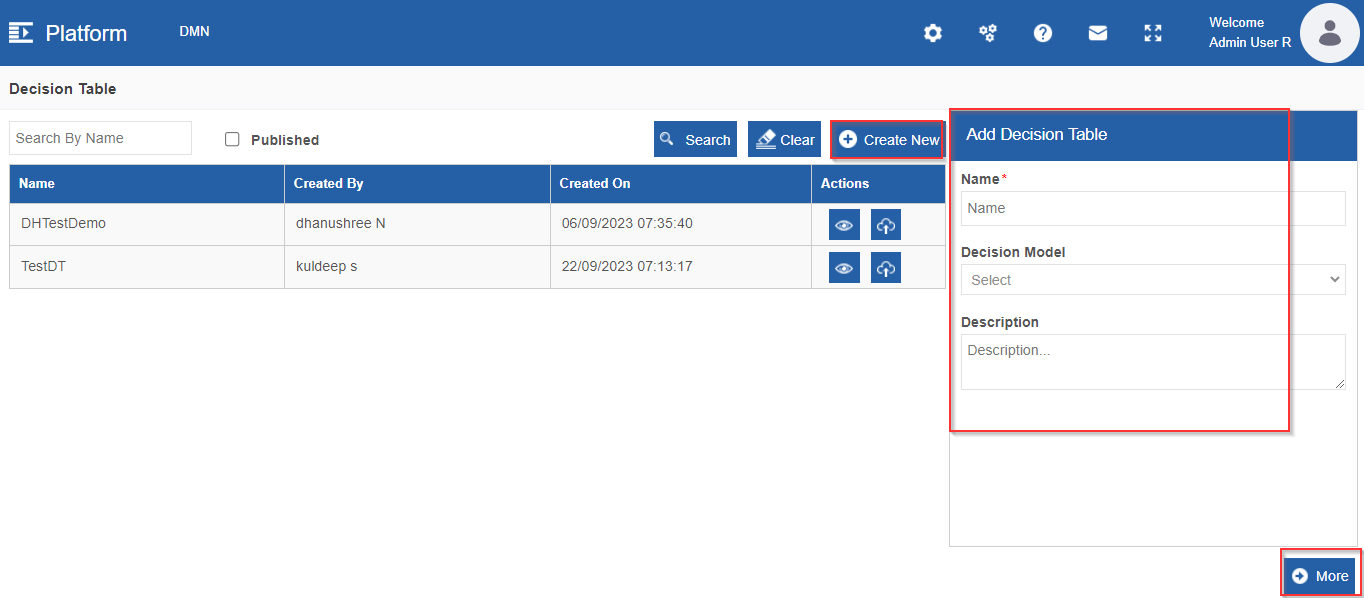
In the widget configuration (Control Panel icon > Options > Configuration) select Decision Table and click Save. The decision Table list appears on the page. (If you do not see any change in the page, refresh the page.)
-
Click Create New.
-
In the Add Decision Table panel, enter the details.
Field Description Name Enter name for the decision table. Decision Model Select the decision model required.
The decision models that are created in the Decision Model portlet
(widget) appears in the drop-down list.Description Enter description for the decision table if any. -
Click More. The configuration details of the decision table appears.
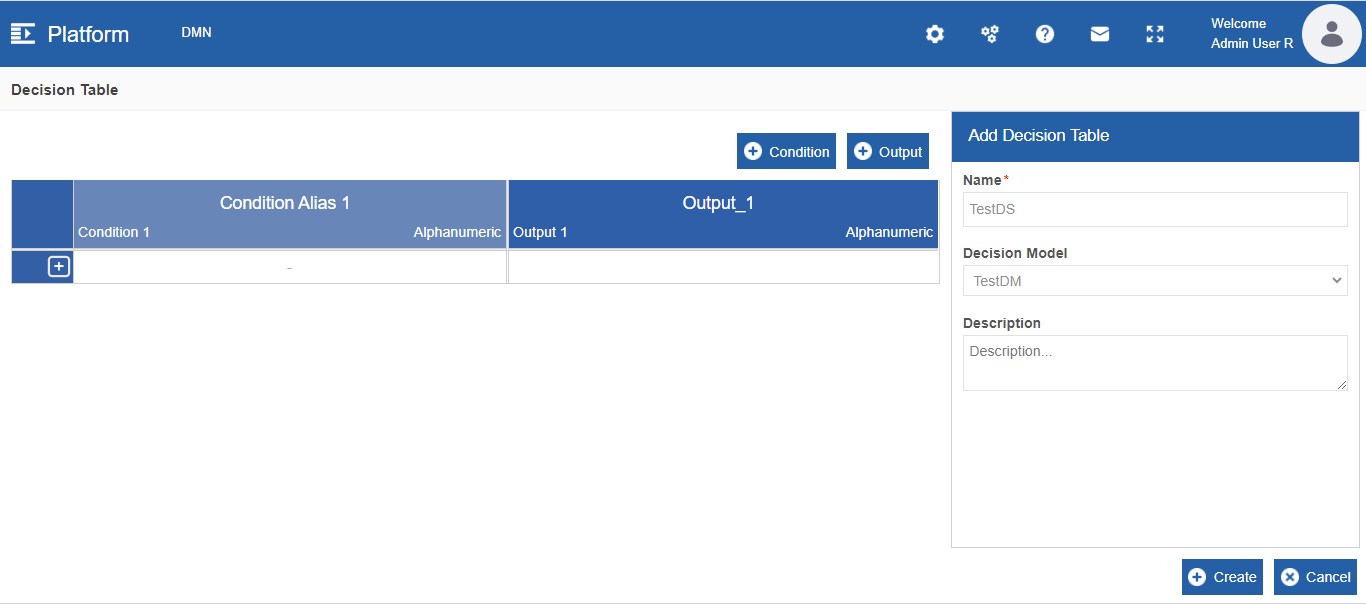
Figure 9: Decision Table configuration -
Click the Condition button for adding an input column (or condition column) and click Output button for adding an Output column. Refer to Adding Condition Columns and Managing Condition Columns for more details.
-
Click “+” (Add Rule) for adding rules for the condition. Refer to Adding Rules for the Conditions and Managing Rules for the Conditions.
-
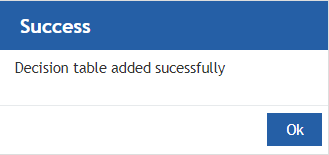
Click Create. A success message appears on successful creation of decision table.
-
Click Ok. A decision Table with the provided details is created.
Adding Condition Column
-
Navigate through Main menu > BRMS page > Configure Decision Table.
-
Click Create New for creating a new decision table or click eye icon of an existing decision table for editing details.
-
Click More for displaying the Decision Table configuration and rule details.
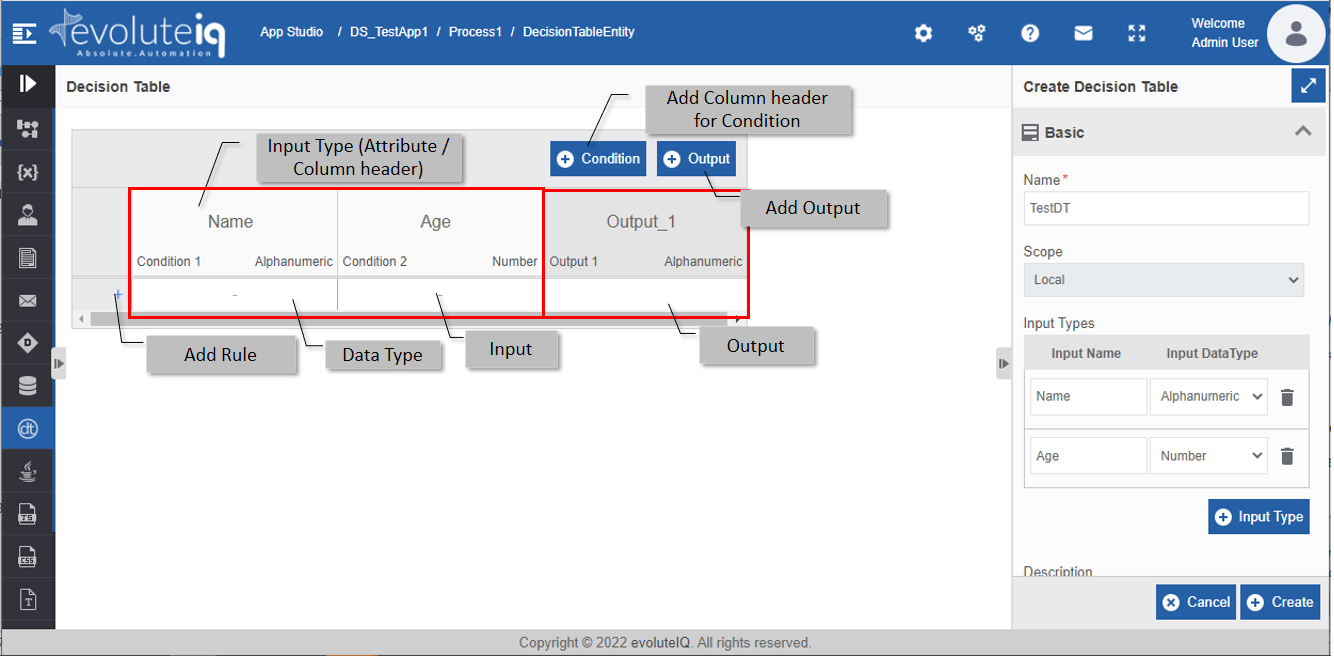
Figure 10: Decision Table configuration elements -
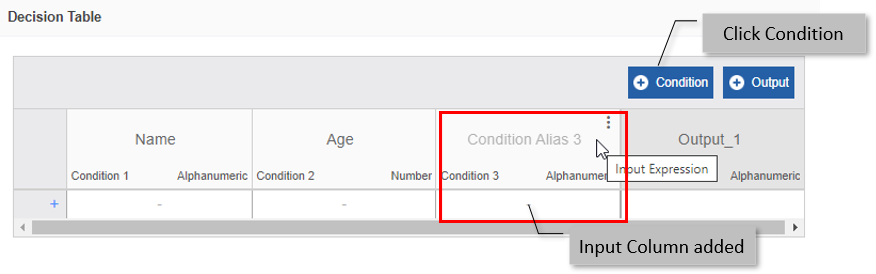
Click +Condition. A new condition column is added as the last column of the input columns.
-
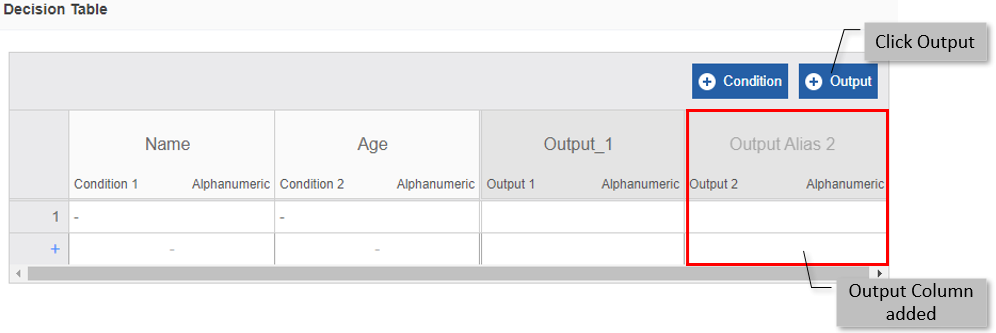
Click +Output for adding an Output column.
-
For adding columns in a specific order, hover over a column and three dots appear. You can select the Input column (with while column headers) for adding input columns or Output columns (with greyed column headers) for adding output columns.
-
Hover over a column and click the three dots for viewing More Condition Options. The More condition options are the same for the Input and Output columns.
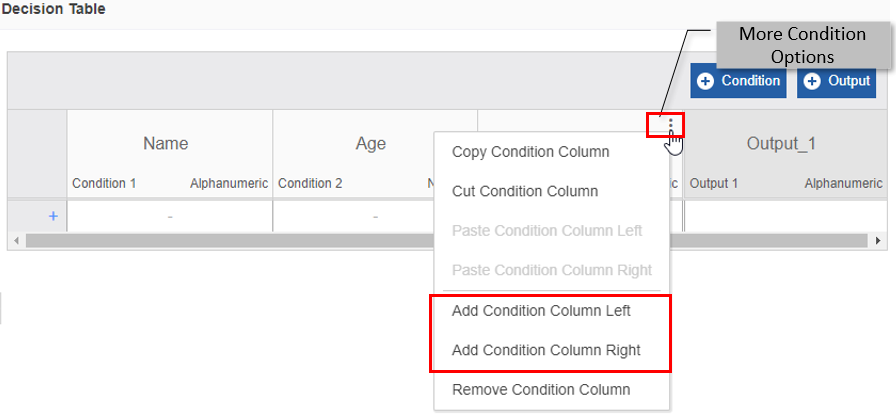
-
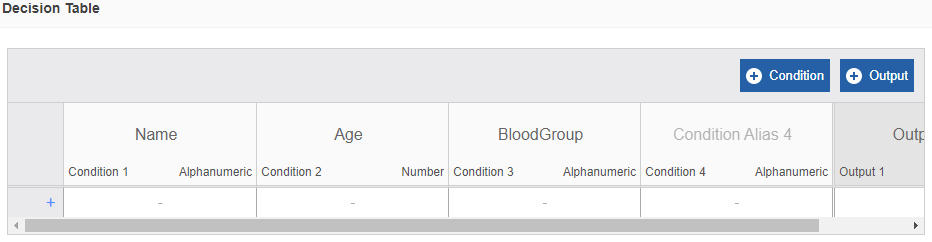
In the More Condition Options, click Add Condition Column Right for adding a new Condition Column to the right of the current column.
-
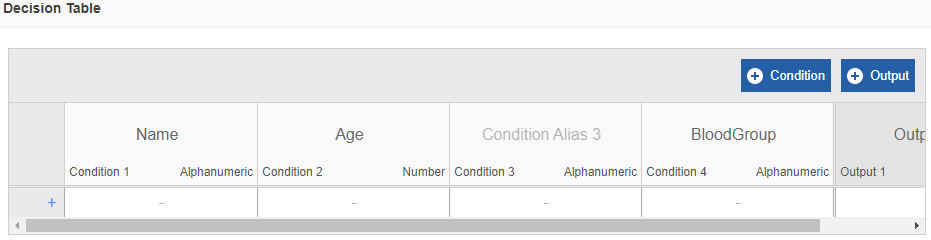
In the More Condition Options, click Add Condition Column Left for adding a new Condition Column to the left of the current column.
Managing Condition Columns
You can edit the labels in the condition columns. Cut/copy-paste features are also available for conditions columns by which you can cut/copy a column and paste in the desired order.
-
Navigate through Main menu > BRMS page > Configure Decision Table.
-
Click eye icon of the existing decision table.
-
Click More for displaying the Decision Table configuration and rule details.
-
Hover over a column and click the three dots for viewing More Condition Options. The More condition options are the same for the Input and Output columns.
-
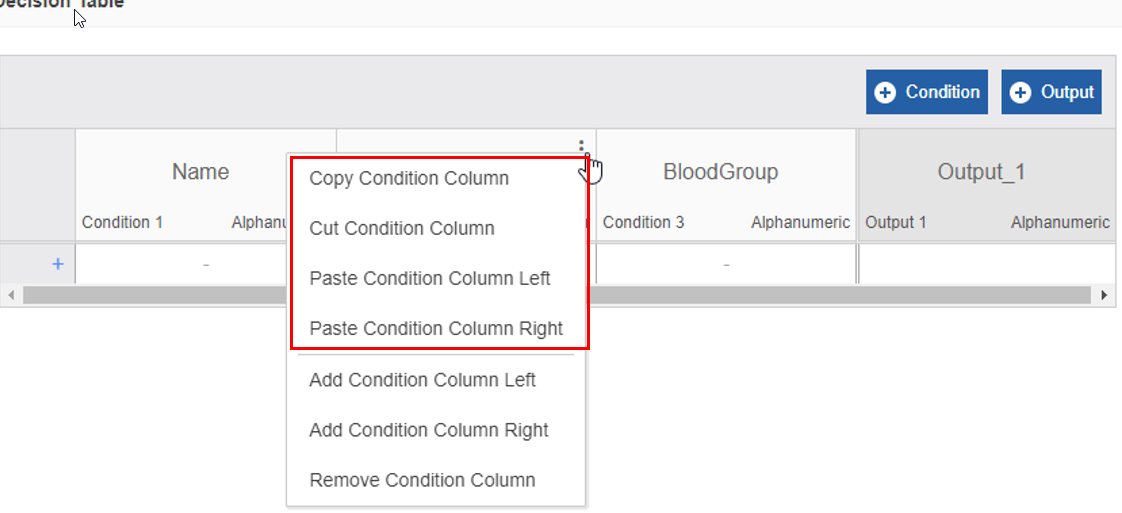
In the More Condition Options, click Copy Condition Column for copying a condition column.
-
In the More Condition Options, click Cut Condition Column for cutting the current column from the position. Once you copy or cut a condition column and click More Condition Options, the Paste options are enabled.
-
In the More Condition Options, click Paste Condition Column Left for pasting the copied (or cut) condition to the left of the current column.
-
In the More Condition Options, click Paste Condition Column Right for pasting the copied (or cut) condition to the right of the current column. You can paste the copied or cut column only one time. If you want more copies, you need to copy them again.
-
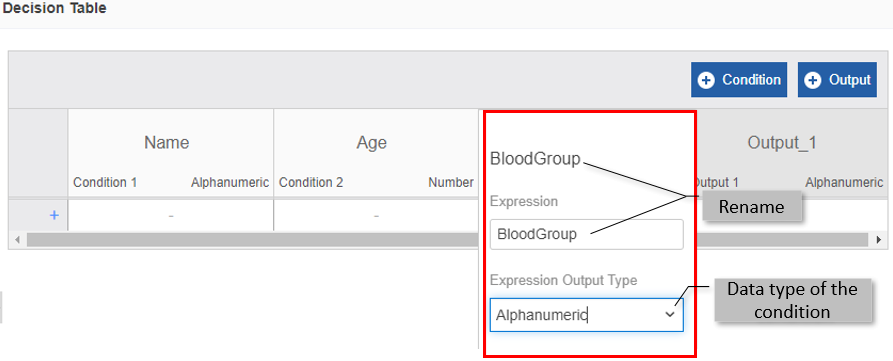
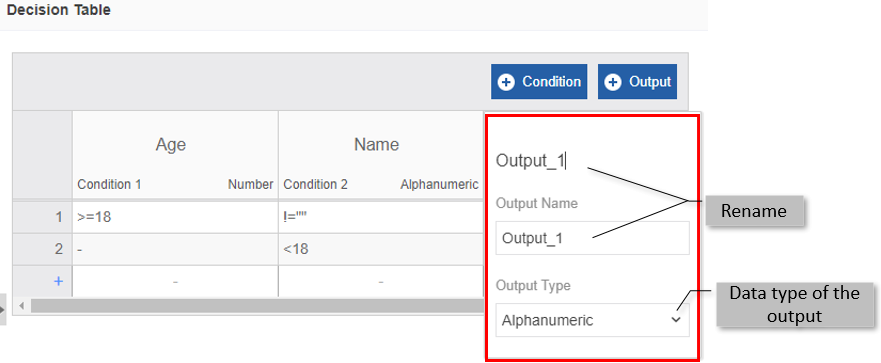
For changing the column header name, double click the column name (default column name is Condition Alias n when you add a new input column header or Output Alias n when you add a new output header, where n is the number of the column as per appearance in the UI).
-
Click the header and type the new header name or enter the column header name below Expression (for input column) /Output Name (for output column)
-
Select the required data type from Expression Output Type (for input column)/Output Type (for output column).
-
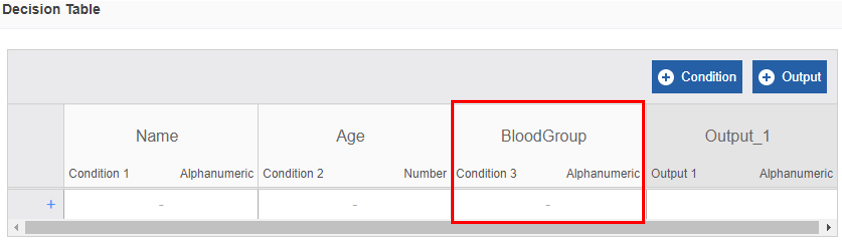
Click outside Rename panel for viewing the updated details.
Removing Condition Column
- Navigate through Main menu > BRMS page > Configure Decision Table.
- Click eye icon of the existing decision table for which you need to remove condition column.
-
Click More for displaying the Decision Table configuration and rule details.
-
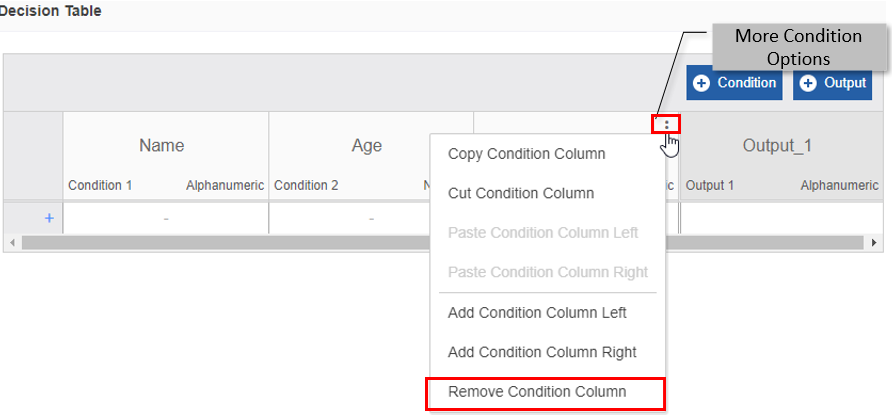
Hover over a column and click the three dots for viewing More Condition Options. The More condition options are the same for the Input and Output columns.
-
In the More Condition Options, click Remove Condition Column for removing the selected condition column.
Adding Rules for the Condition
The rules for the conditions or input/output columns are written in FEEL. FEEL is a part of the DMN specification. It is designed to write expressions for decision tables and literal expressions in a simple way that is easily understood by business professionals and developers.
Refer to FEEL before configuring the rules for the decision table.
-
Navigate through Main menu > BRMS page > Configure Decision Table.
-
Click eye icon of the existing decision table for adding rules.
-
Click More for displaying the Decision Table configuration and rule details.
-
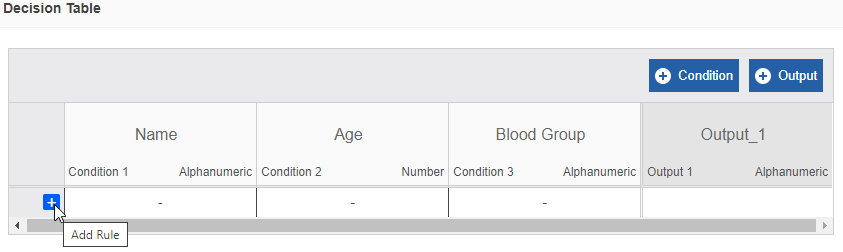
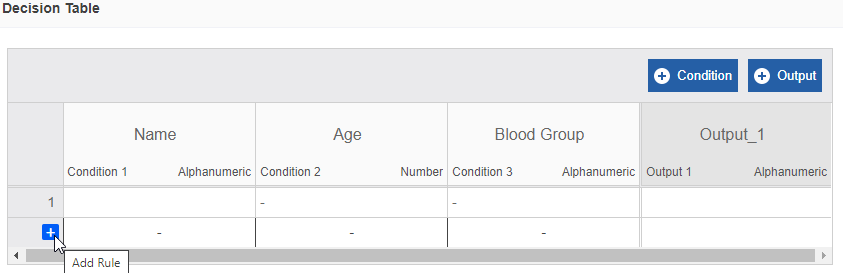
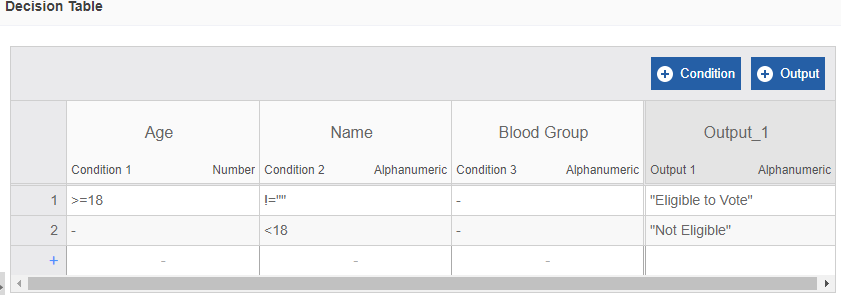
Click “+” for adding a rule. A new rule row appears with the number “1”.
-
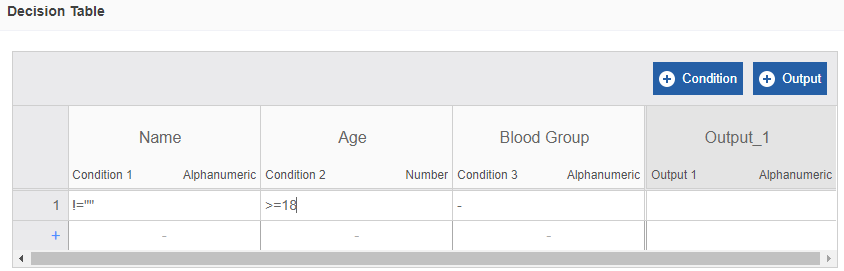
Enter the rule expression as per your requirement. Rules are written in FEEL.
The rule for the “Name” column should be written below the “Name” column (E.g., Name not equal to blank) and that will be condition 1. The rule for the “Age” column should be written below the “Age” column (E.g., Age greater than or equal to 18) and that will be condition 2. And so on. If you do not want to define a rule for a column, enter a hyphen (-) in that column. By default, columns that do not have any rule display hyphen.
-
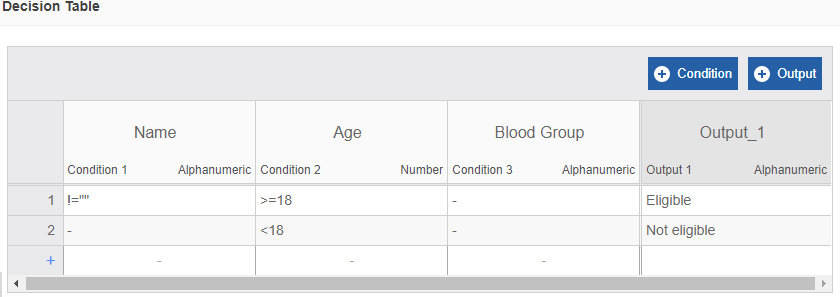
Enter the output value below the relevant output column. That is, the output for specified columns is to be written below the specific output columns.
-
For adding columns in a specific order, hover over the numeral column on the left, three dots appear.
-
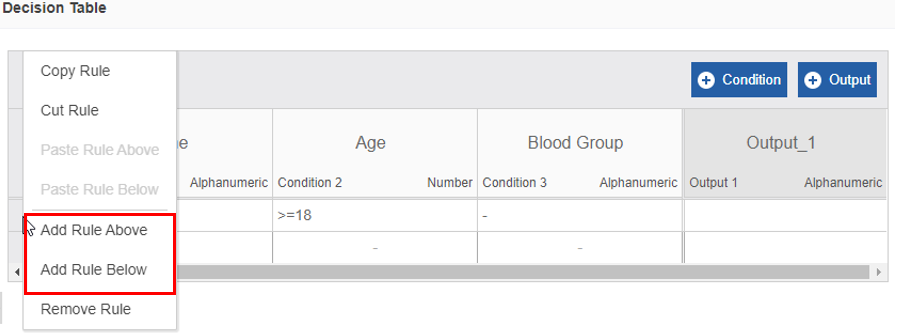
Click three dots. More Rule Options appear.
-
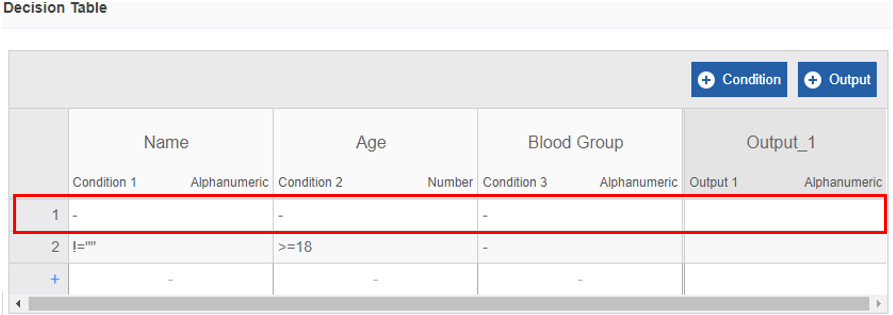
In the More Rule Options, click Add Rule Above for adding a new Rule above the current rule.
-
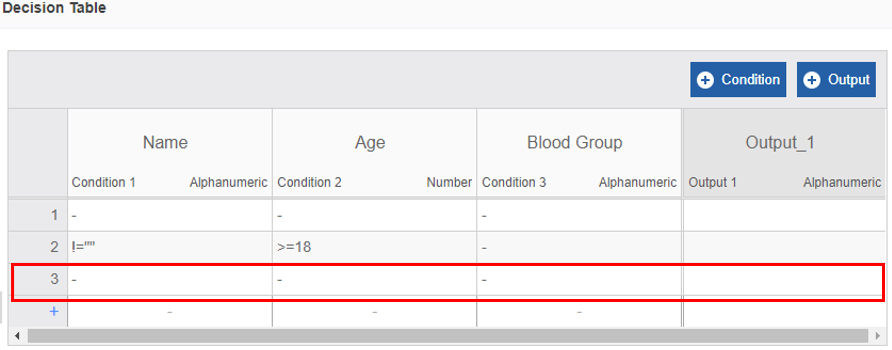
In the More Rule Options, click Add Rule Below for adding a new Rule below the current rule.
Managing Rules for the Conditions
-
Navigate through Main menu > BRMS page > Configure Decision Table.
-
Click eye icon of the existing decision table for editing details.
-
Click More for displaying the Decision Table configuration and rule details.
-
Hover over the numeral column on the left, and three dots appear.
-
Click three dots. More Rule Options appear.
-
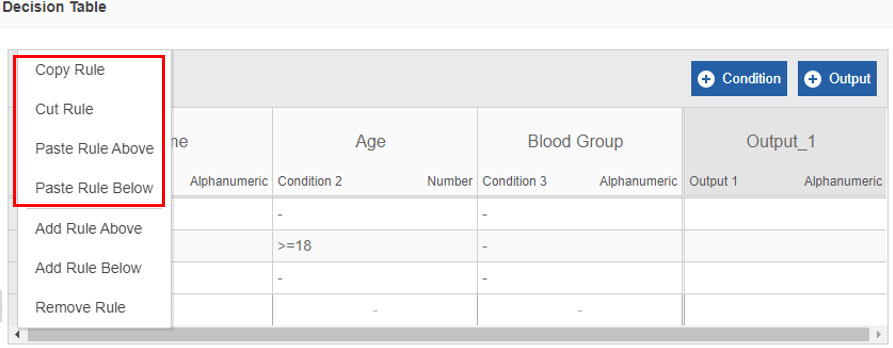
In the More Rule Options, click Copy Rule for copying a rule.
-
In the More Rule Options, click Cut Rule for cutting the current rule from the position. Once you copy or cut a rule and click More Rule Options, the Paste options are enabled.
-
In the More Rule Options, click Paste Rule Above for pasting the copied (or cut) rule above the current rule.
-
In the More Rule Options, click Paste Rule Below for pasting the copied (or cut) rule below the current rule.
You can paste the copied or cut rule only one time. If you want more copies, you need to copy them again.
Removing Rules
-
Navigate through Main menu > BRMS page > Configure Decision Table.
-
Click eye icon of the existing decision table for removing rules.
-
Click More for displaying the Decision Table configuration and rule details.
-
Hover over the numeral column on the left, and three dots appear.
-
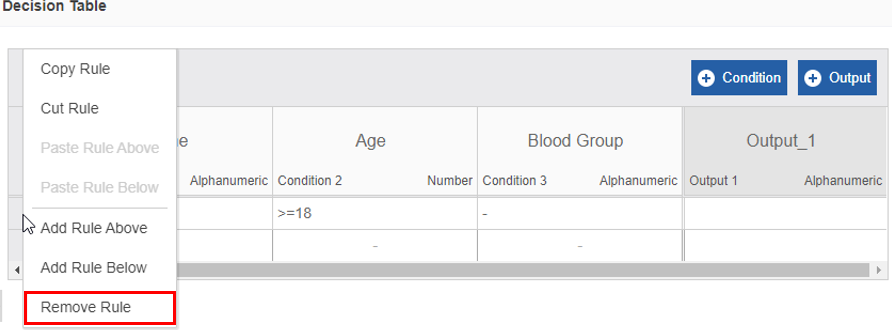
Click three dots. More Rule Options appear.
-
In the More Rule Options, click Remove Rule for removing the selected rule.
Publishing a Decision Table
The published decision tables from the decision table page are saved in the background.
-
Navigate through Main menu > BRMS page > Configure Decision Table.
-
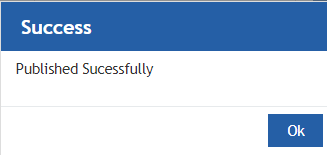
In the Actions column, click Publish icon for the decision table that you want to publish. A Success message appears.
-
Click OK. The decision table is now published with a version. When you publish a decision table for the first time, the version will be “1”. Next time when you publish, the version will be “2” and so on.
Searching for the Published Decision Tables
You can search for the published tables to view the published decision tables.
-
Navigate through Main menu > BRMS page > Configure Decision Table.
-
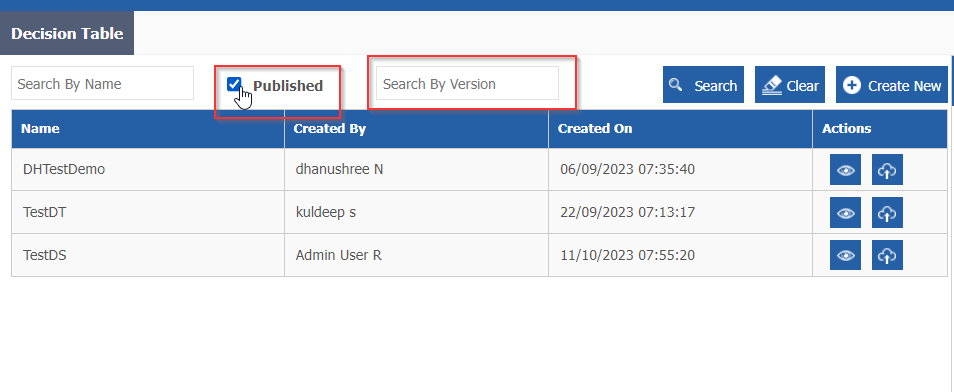
Click the Published checkbox. Select By Version box appears.
-
In the Search By Version box, enter the published version number that you are looking for.
-
Click Search. All the decision tables which are published with the given version get listed. If you do not give any version number in the Search By Version box, all the versions of all the published decision tables will be displayed.
The decision tables will appear with a column indicating the version number and the Actions column will display an execute button.
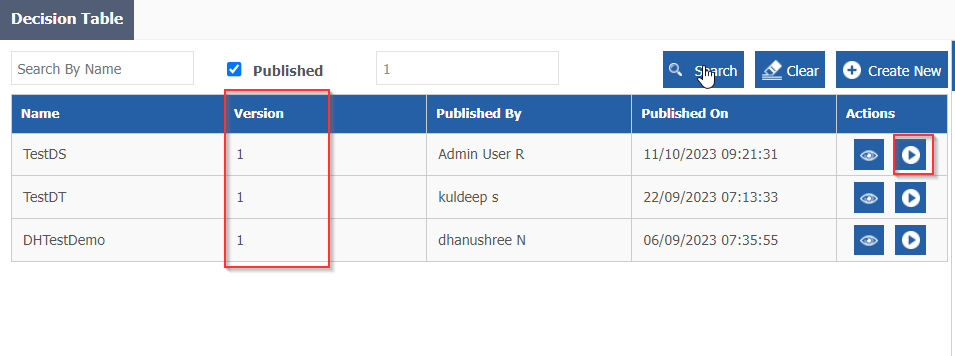
Figure 11: Published decision tables of a particular version
Executing a Decision Table
You can execute the published decision tables.
- Navigate through Main menu > BRMS page > Configure Decision Table.
-
Click the Published checkbox. Select By Version box appears.
-
In the Search By Version box, enter the published version number that you are looking for.
-
Click Search. All the decision tables which are published with the given version get listed. The Actions column will display an execute button.
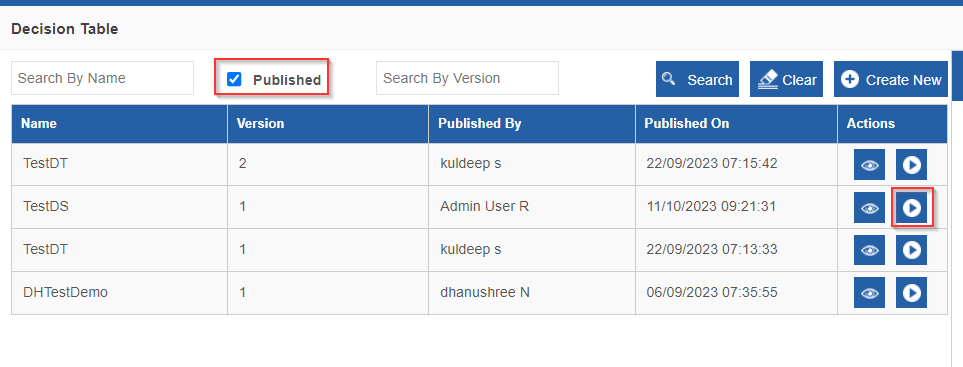
Figure 12: Executing a Decision Table -
In the Actions, click Execute icon. Execute Decision Table pop-up appears.
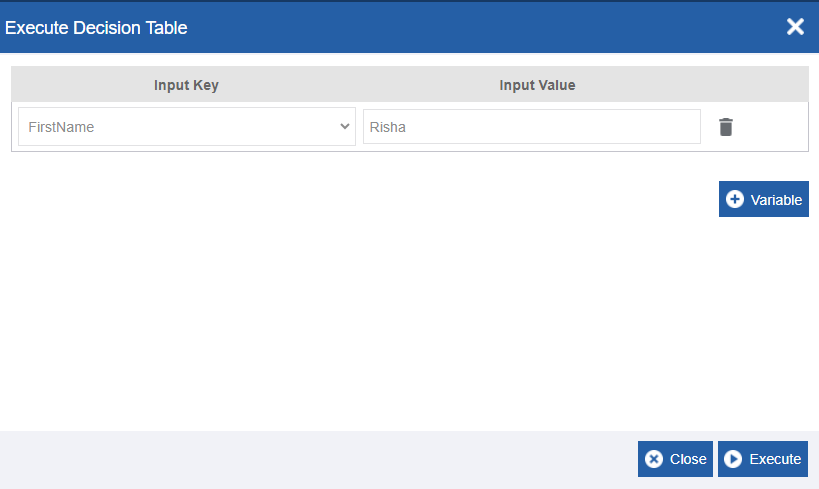
Figure 13: Entering input key and value for the decision table -
In the Input Key, click and select the input key.
-
In the Input Value, enter the value for the key.
-
Click Variable. One more input column appears where you can select the Input Key and Input Value. The Variable button appears only if it is applicable. That is, if there is more inputs, it will appear and if all the inputs are configured, Variable button will not appear.
-
Click Execute. Return data will appear with the status of the execution.
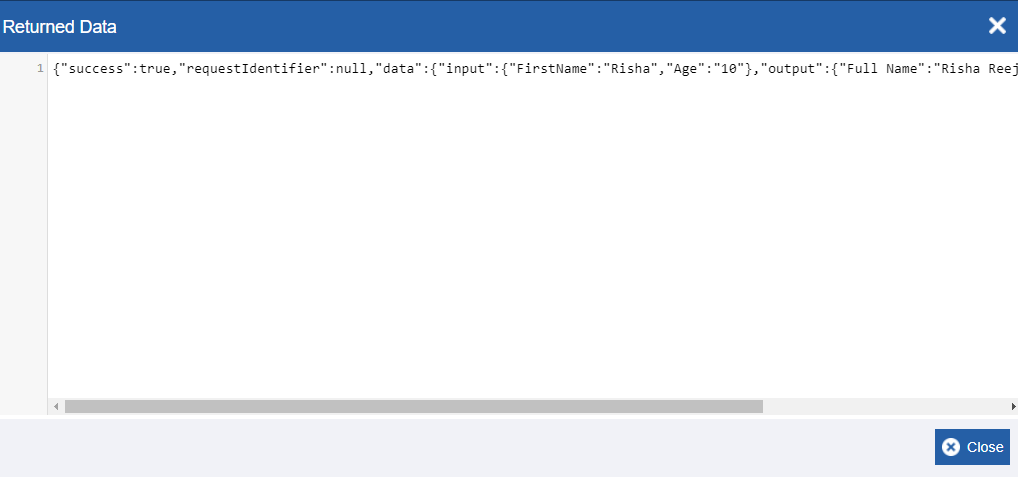
Figure 14: Execution result in Returned Data
Deleting a Decision Table
- Navigate through Main menu > BRMS page > Configure Decision Table.
-
Click an existing decision table that you want to delete.
-
In the Actions, click the eye icon.
-
Click More.
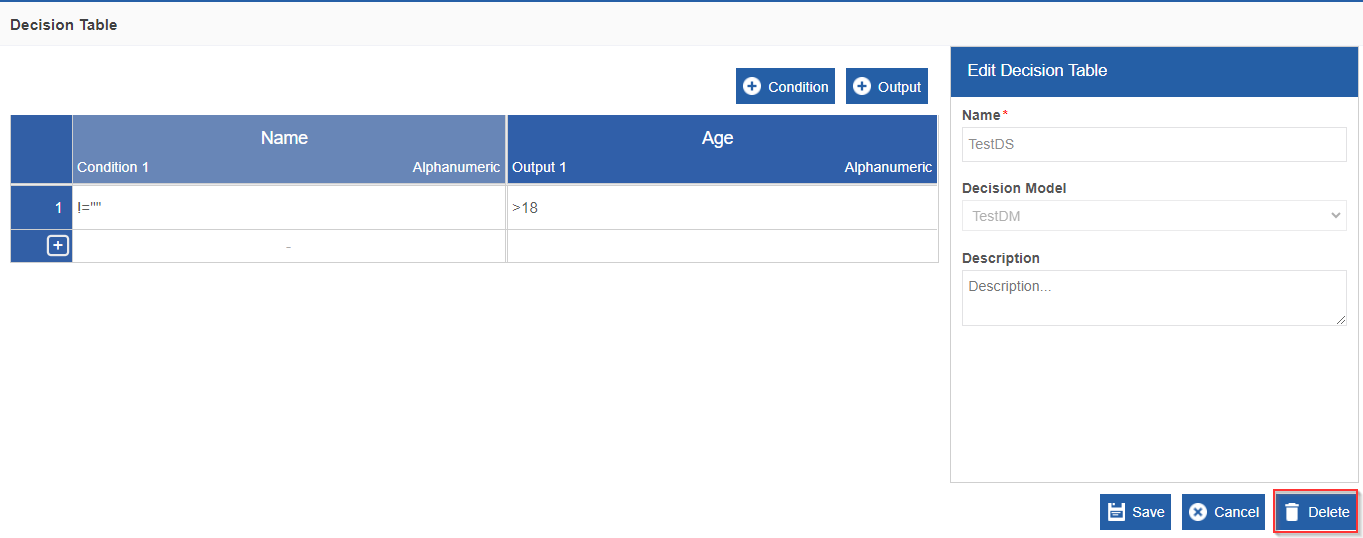
Figure 15: Deleting a decision table -
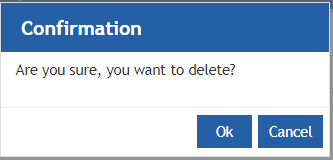
Click Delete. Delete Confirmation appears.
-
Click OK. The decision table gets deleted.
Decision Table Utilization
Associating Portlet Decision Table in Process Flows
The decision tables that are created in the Decision table portlet can be utilized in the process flows by using the webservice activity in the process flow or by using Javascript in the Form.
Decision Table portlet API is an exposed API and you need to call that API through the webservice activity by providing appropriate details.
Refer to the BRMS Portlet API documentation for more details.